
The Exponential Framework for Net Zero
The fastest economic transition in history is underway. The Exponential Framework guides companies to both reduce emissions and scale climate solutions—transforming business models for competitive advantage while contributing to global net zero.
Pathway to 1.5°C and Global Net Zero
The framework divides climate action into two complementary strategies: Reducing emissions through operational improvements and value chain decarbonization, and Enabling systemic change through climate solutions, sustainable finance, and policy advocacy. These pillars work together to create reinforcing loops—climate solutions drive investment, which enables policy change, which accelerates further emissions reductions.
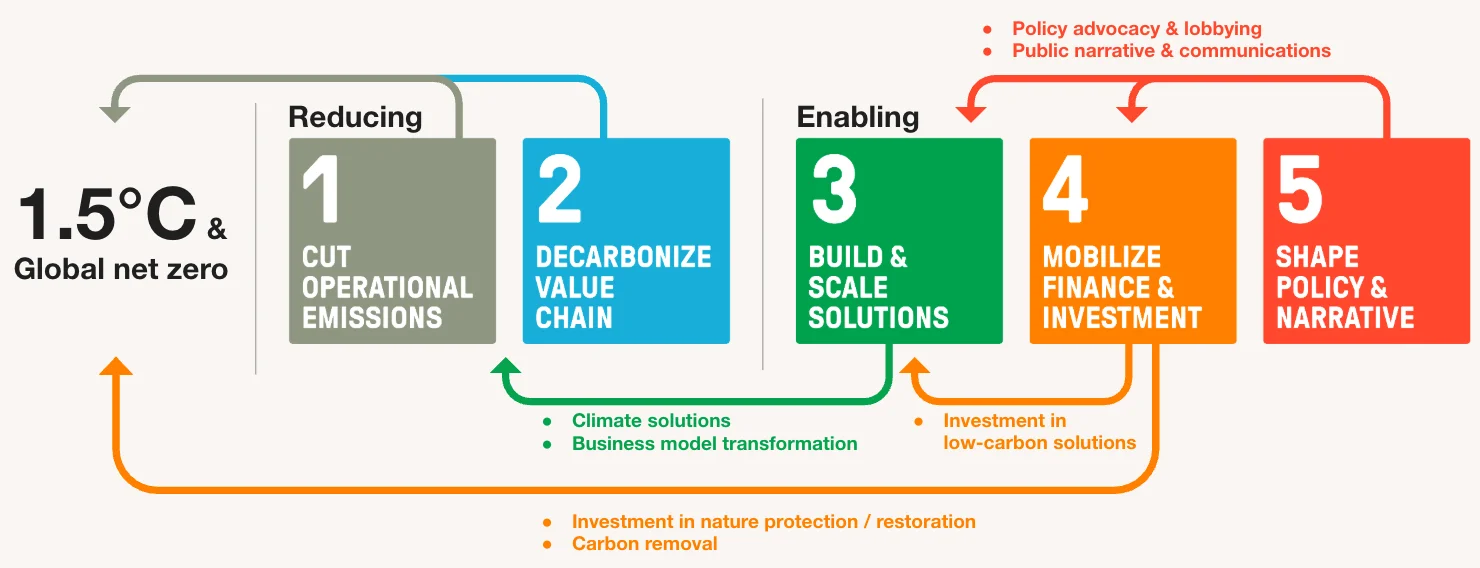
Reducing Emissions (Pillars 1-2)
Direct emissions cuts through operational efficiency, renewable energy, and value chain engagement. These pillars focus on eliminating emissions at their source.
Enabling Transformation (Pillars 3-5)
Systemic change through climate solutions, sustainable investment, and policy advocacy. These pillars create the conditions for economy-wide decarbonization.
Three Levels of Action Across All Pillars
Each pillar requires action at three levels: Set Targets & Strategy to establish direction and commitment, Develop Transition Plan & Take Action to implement concrete measures, and Report & Communicate to ensure transparency and accountability. This structured approach ensures companies move from ambition to measurable impact.
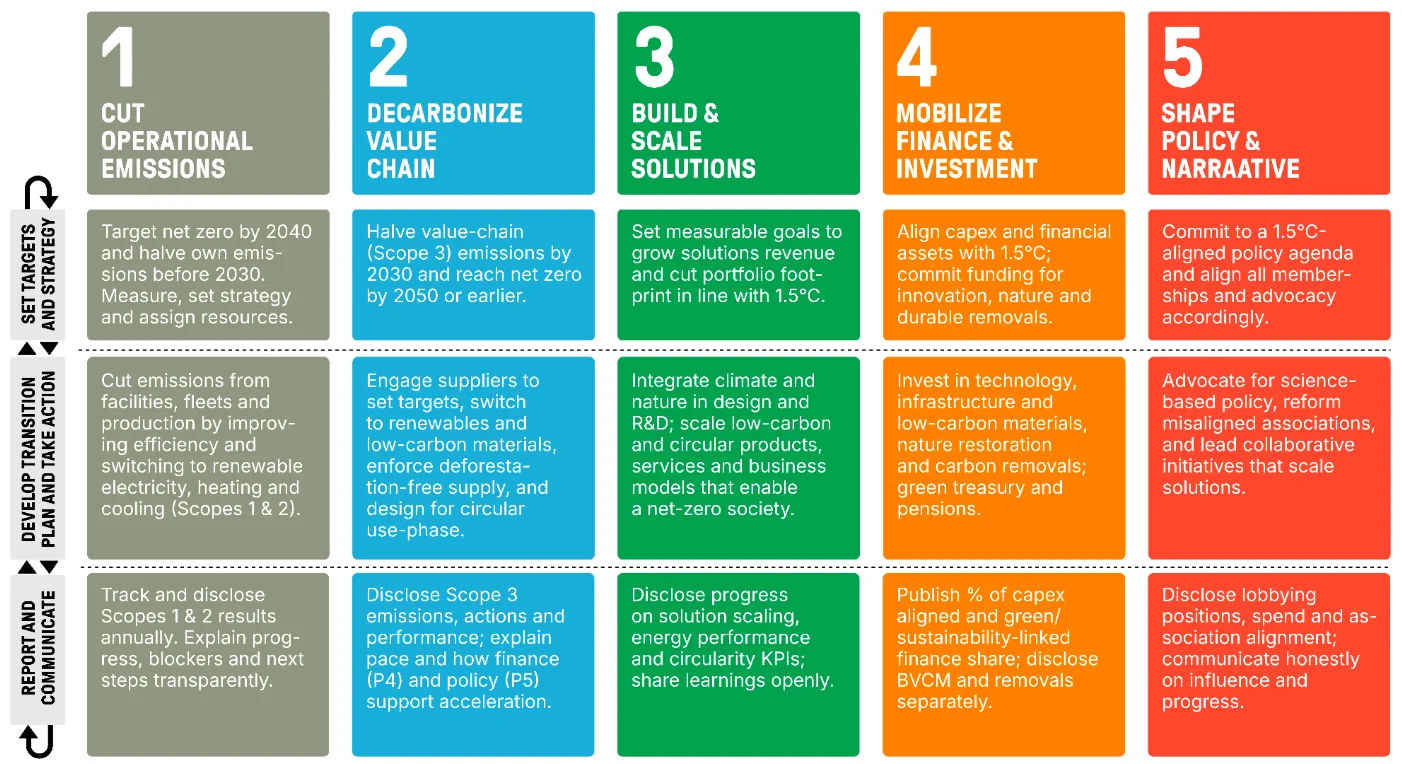
Key Insight: The framework's power lies in its integration. Companies that address all five pillars simultaneously create reinforcing effects—operational savings fund climate solutions, which attract sustainable investment, which enables policy advocacy, which accelerates the transition.
Impact Varies by Company Type
Where a company can have the biggest climate impact depends on their sector and business model. A steel company's climate story is fundamentally different from a bank's or a consultancy's.
Heavy Industry
Stegra (Green Steel)
Operations-dominant: Decarbonizing production IS the climate story
Professional Services
AFRY (Engineering)
Solutions-dominant: Enabling others' climate transformation
Banking & Finance
Handelsbanken
Finance-dominant: Impact through capital allocation
Automotive
Polestar
Balanced P2+P3: Materials supply chain + zero-emission products
Industrial Equipment
Alfa Laval
Solutions-dominant: Products halve customer carbon footprint
Understanding the Pillar Bars
Each bar represents a pillar's relative importance for that company type. Taller bars = bigger impact potential. P1 P2 P3 P4 P5
Learn how we calculate pillar weightsFive Pillars of Transformation
Two pillars focus on reducing emissions (operational and value chain), while three pillars enable systemic transformation (solutions, finance, and policy). Each pillar contains specific action categories where companies demonstrate leadership.

Cut Operational Emissions
Transform operations through efficiency and electrification
Target: Net zero by 2040, halve before 2030
Action Categories:
Buildings & Factories
Energy efficiency, renewable electricity, heat pumps
Fleet & Logistics
Electric vehicles, route optimization, modal shift
Energy Supply
100% renewable PPAs, on-site generation, storage

Decarbonize Value Chain
Drive systemic change through supplier engagement
Target: Halve Scope 3 emissions by 2030
Action Categories:
Supplier Engagement
SBTi targets, renewable energy requirements, capacity building
Supplier Materials & Products
Low-carbon materials, circular design, sustainable sourcing

Build & Scale Solutions
Transform your portfolio for climate-positive growth
Target: Grow solutions revenue, cut portfolio footprint
Action Categories:
Product Efficiency & Technology Innovation
Energy-efficient products, lifecycle improvements
Climate Solutions: Innovate & Scale
New climate solutions, avoided emissions measurement
Business Model & Value Chain Transformation
Circular models, service-based offerings

Mobilize Finance & Investment
Deploy capital to accelerate the transition
Target: Align capex and financial assets with net zero
Action Categories:
Technology, Infrastructure
Green bonds, climate-aligned capex, R&D investment
Nature, Removals
Nature-based solutions, carbon removal, restoration

Shape Policy & Narrative
Set the rules of the new economy through advocacy
Target: Commit to 1.5°C-aligned policy agenda
Action Categories:
Direct Lobbying & Advocacy
1.5°C-aligned lobbying, association review, policy advocacy
Public Narrative & Communications
Climate leadership communications, stakeholder engagement
Want to explore each pillar in depth? Visit our dedicated pillar pages:
Performance Levels
Companies progress through four performance levels in each action category. Our assessment helps identify where you are and what's needed to advance.
Leading
Industry-leading practices with transparent reporting and advocacy
Advancing
Implementing transition plans with measurable progress
Starting
Targets set, beginning to develop transition plans
Not Yet
Opportunity to begin climate action in this category
Growth and Emissions Are Decoupling
Leading companies are proving that climate action drives competitive advantage, not trade-offs. The "Crocodile Economy" shows 27 companies that have grown revenue while cutting emissions.
Cost Savings
Scopes 1 & 2 emissions cuts = energy cost reductions
Innovation-Led Growth
Climate solutions create new revenue streams
Risk Reduction
Early movers avoid regulatory penalties and supply chain disruptions
Market Leadership
Customers and investors increasingly favor climate leaders
Join 16,000+ Organizations Leading the Transition
The Exponential Framework is the foundation for the world's largest climate action initiatives
Race to Zero members
Revenue represented in ERI
SMEs committed to climate action
Employees in ERI companies
Race to Zero
The UN-backed global campaign rallying leadership and support from businesses, cities, regions, and investors for a healthy, resilient, zero carbon recovery.
16,000 members | 12,000 companies | 690 financial institutions
Exponential Roadmap Initiative
A coalition of companies committed to halving emissions by 2030 through exponential climate action and solutions scaling.
$1 trillion revenue | 2 million employees | Industry leaders across sectors
SME Climate Hub
A global initiative enabling small and medium-sized enterprises to take climate action and build resilience.
9,600+ committed SMEs | Growing network of climate-committed businesses
Science Based Targets initiative
Defines and promotes best practice in emissions reductions and net-zero targets in line with climate science.
Guides near-term emissions reduction targets | Validates company commitments
Ready to Build Your Climate Strategy?
Take our comprehensive assessment to understand your current position across all five pillars and receive a personalized roadmap for action.
Download the full Exponential Business Playbook (PDF)